
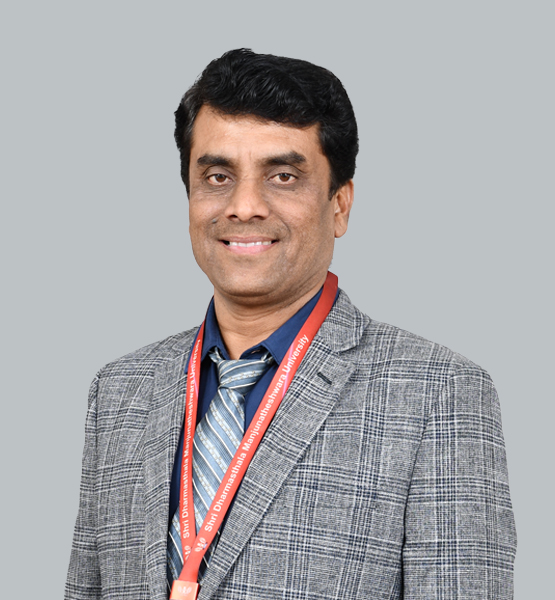
Dr. Satish G. Patil
Satish G. Patil is a Professor of Physiology and Head of Center for Integrated Medicine & Research in SDM College of Medical Sciences & Hospital, SDM University, Karnataka, India. He has published about 50 research papers (43 research papers in a Journal of repute, 4 chapters in a book and 6 conference proceedings); recent one is published in NATURE Medicine (with impact factor 50.0). He has presented his research in India and many countries (Italy, UK, USA, Thialand, UAE). He is an academic editor for PLOS One Journal. He is chairman, member secretary and external member of Ethics Committees. He has received INSPIRE Fellowship from DST, India; Foreign travel grants from CSIR (twice) & Centre for International Cooperation in Science (CICS), Best Poster Award (Italy), three National Awards from Association of Physiologists of India; Young Scientist Award and Gold Medal Awards (twice). Recently, he had received a highest ranked award from American Heart Association ‘Paul Dudhley White International Scholar Award (2020) for contributing highest ranked research from India'. He has a patent for an invention of process for preparation of supported cadmium and nitrate analysis. Currently, he has research grants from NIH, USA; Imperial College of London, ICMR and VGST; and multidisciplinary collaborative research projects with IIT-Madras, and MRU-DIMHANS (Total grant: Rs 150 Lakhs).
- Ongoing Research
- Recent Publications
His research primarily focuses on investigating the mechanisms underlying vascular dysfunction and evaluating integrative approaches—particularly Yoga—that aim to restore cardiovascular health. He is actively involved in developing structured Yoga-based interventions and assessing their effectiveness through clinical trials for cardiovascular disease prevention and management. His work includes clinical trials on arterial stiffness, hypertension in the elderly, myocardial infarction, and diabetes prevention.
He has played a key role in several large multicenter clinical trials, including the Yoga CaRe Trial, Cardiovascular Quality Improvement Program (C-QIP), TOPSPIN Trial, and Yoga-CaRe HF Trial. At his Center for Integrated Medicine and Research (CIMR), the core unit—Laboratory for Advanced Research in Integrative Vascular Physiology (I-VPRL)—is currently investigating the impact of Yoga-based cardiac rehabilitation and yoga lifestyle on endothelial function, genomics, arterial stiffness, gut microbiome, gut-heart-mind axis and gut-metabolic axis in heart failure and diabetes. These studies aim to elucidate both the clinical efficacy and molecular mechanisms by which Yoga benefits patients with cardiovascular disease or risk.
Additionally, his research has identified key molecular targets associated with improved clinical outcomes, potentially guiding future therapeutic strategies. He is also exploring the role of Yoga lifestyle in prevention of vascular complications in diabetes and in modulating the vascular aging process.
- Prabhakaran D, Chandrasekaran AM, Singh K, Mohan B, Chattopadhyay K, Chadha DS, Negi PC, Bhat P, Sadananda KS, Ajay VS, Singh K. et. Al. Yoga-based cardiac rehabilitation after acute myocardial infarction: a randomized trial. Journal of the American College of Cardiology. 2020 Apr 7;75(13):1551-61.
- Patil SG, Aithala MR, Naregal GV, Shanmukhe AG, Chopade SS. Effect of yoga on cardiac autonomic dysfunction and insulin resistance in non-diabetic offspring of type-2-diabetes parents: A randomized controlled study. Complementary therapies in clinical practice. 2019 Feb 1;34:288-93.
- Patil SG, Biradar MS, Khode V, Vadiraja HS, Patil NG, Raghavendra RM. Effectiveness of yoga on arterial stiffness: A systematic review. Complementary Therapies in Medicine. 2020 Aug 1;52:102484.
- Patil SG, Aithala MR, Das KK. Effect of yoga on arterial stiffness in elderly subjects with increased pulse pressure: A randomized controlled study. Complementary therapies in medicine. 2015 Aug 1;23(4):562-9.
- Patil SG, Patil SS, Aithala MR, Das KK. Comparison of yoga and walking-exercise on cardiac time intervals as a measure of cardiac function in elderly with increased pulse pressure. Indian heart journal. 2017 Jul 1;69(4):485-90.